

Stay Up-To-Date with Political Events
News & Video
Republican Reconciliation Bill Remains Deeply Unpopular
The Republican reconciliation bill passed by the U.S. Congress remains deeply unpopular with voters as general familiarity with the legislation trends upward, new polling released by Senate Majority PAC has found.
Fifty-nine percent of voters say they’re at least somewhat familiar with the contents of the GOP reconciliation bill, while support for the legislation is underwater, with 35% supporting to 43% opposed. Support for the bill drops substantially, however, to a net -20 percentage points, when voters are presented with a neutral set of facts about the bill. Critically, the legislation is polarizing with swing voters, with 49% saying they are less likely to support their representative in the 2026 election if that lawmaker voted for the bill.
Republican messaging on the bill also fails to connect with voters, the survey found. When presented with both Republican and Democratic messaging on the legislation, voters continued to hold unfavorable views of the bill, showing that even the “best” GOP messaging on the bill still does not persuade a majority of voters to support the legislation.
Key Findings
-
59% of voters say they’re at least somewhat familiar with the contents of the GOP reconciliation bill – up 6pp from early June.
-
Without any context on the bill’s contents, voters have net-8pp support for the Republican budget – 35% support to 43% opposed. This is the same margin of support in early June – with baseline support and baseline opposition to the bill both increasing slightly (from 33/41).
-
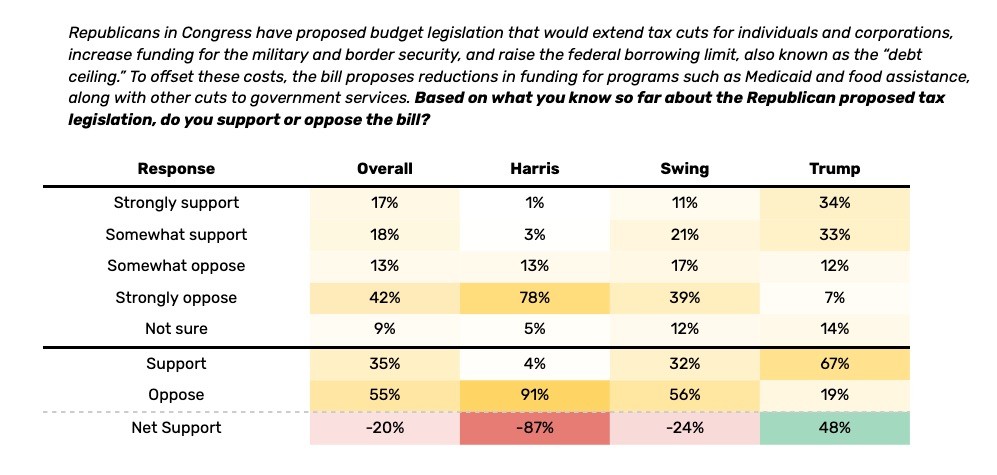
That said, support drops substantially, down to net -20pp, among a subset of voters who see a neutral set of facts about the bill. Only 25% of voters overall support the bill, compared to 55% who are opposed. The margin is net -24pp among swing voters (32/56).
Republicans in Congress have proposed budget legislation that would extend tax cuts for individuals and corporations, increase funding for the military and border security, and raise the federal borrowing limit, also known as the “debt ceiling.”
To offset these costs, the bill proposes reductions in funding for programs such as Medicaid and food assistance, along with other cuts to government services. Based on what you know so far about the Republican proposed tax legislation, do you support or oppose the bill?
-
50% of voters say they’re less likely to support their representative in the upcoming election if they vote for this bill, after being shown this description. This includes 49% of swing voters and even 17% of Trump 2024 voters.
-
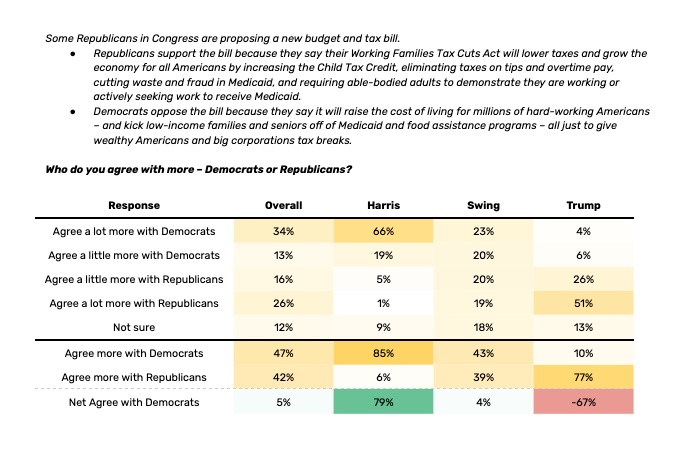
In a final question with both Republican and Democratic argumentation about the bill, voters still side with Democrats in opposition to the bill by 5pp (47% to 42%). This demonstrates that even the “best” GOP messaging on the bill still does not persuade a majority of voters to support their legislation.
Some Republicans in Congress are proposing a new budget and tax bill.
-
Republicans support the bill because they say their Working Families Tax Cuts Act will lower taxes and grow the economy for all Americans by increasing the Child Tax Credit, eliminating taxes on tips and overtime pay, cutting waste and fraud in Medicaid, and requiring able-bodied adults to demonstrate they are working or actively seeking work to receive Medicaid.
-
Democrats oppose the bill because they say it will raise the cost of living for millions of hard-working Americans – and kick low-income families and seniors off of Medicaid and food assistance programs – all just to give wealthy Americans and big corporations tax breaks.
-
Who do you agree with more – Democrats or Republicans?
Read the full polling memo.
The poll was conducted by Blue Rose Research between July 2-3, 2025, collecting 4,097 responses via online web panels to gauge voters’ attitudes toward the Republican budget reconciliation bill signed into law on Friday. The margin of error is ± 1.4.
###